


How Labor Costs Support the Community
Why paying Union workers more strengthens the local economy
Every new construction project comes with costs and estimates, and often those costs are considered by city or local officials, sometimes in the form of several bids from different contractors and firms.
Along with materials, equipment, fees, and more, a significant portion of those costs are going to be labor estimates (usually 20-25 percent of the total value of the project). It’s probably not uncommon for officials to look for the most cost-effective bid, the option that will reduce the load the most on the city’s coffers. While understandable, those low-cost bids can often be the ones that underpay workers and strive to cut Union workers out of the equation entirely.
The irony here is that in choosing the cheapest bid, city officials can inadvertently do their local communities a disservice and damage the local economy. When Union workers go to city meetings and advocate for new projects and for their involvement, it helps to understand that we are not just advocating for our paychecks – we are also advocating for our communities, and for improving our local economies.
A tool we can use to help city officials realize the long-term benefits of choosing Union labor is the multiplier effect. It’s a simple concept, but overlooked as officials focus exclusively on the bottom line of looking at the direct costs of a project.
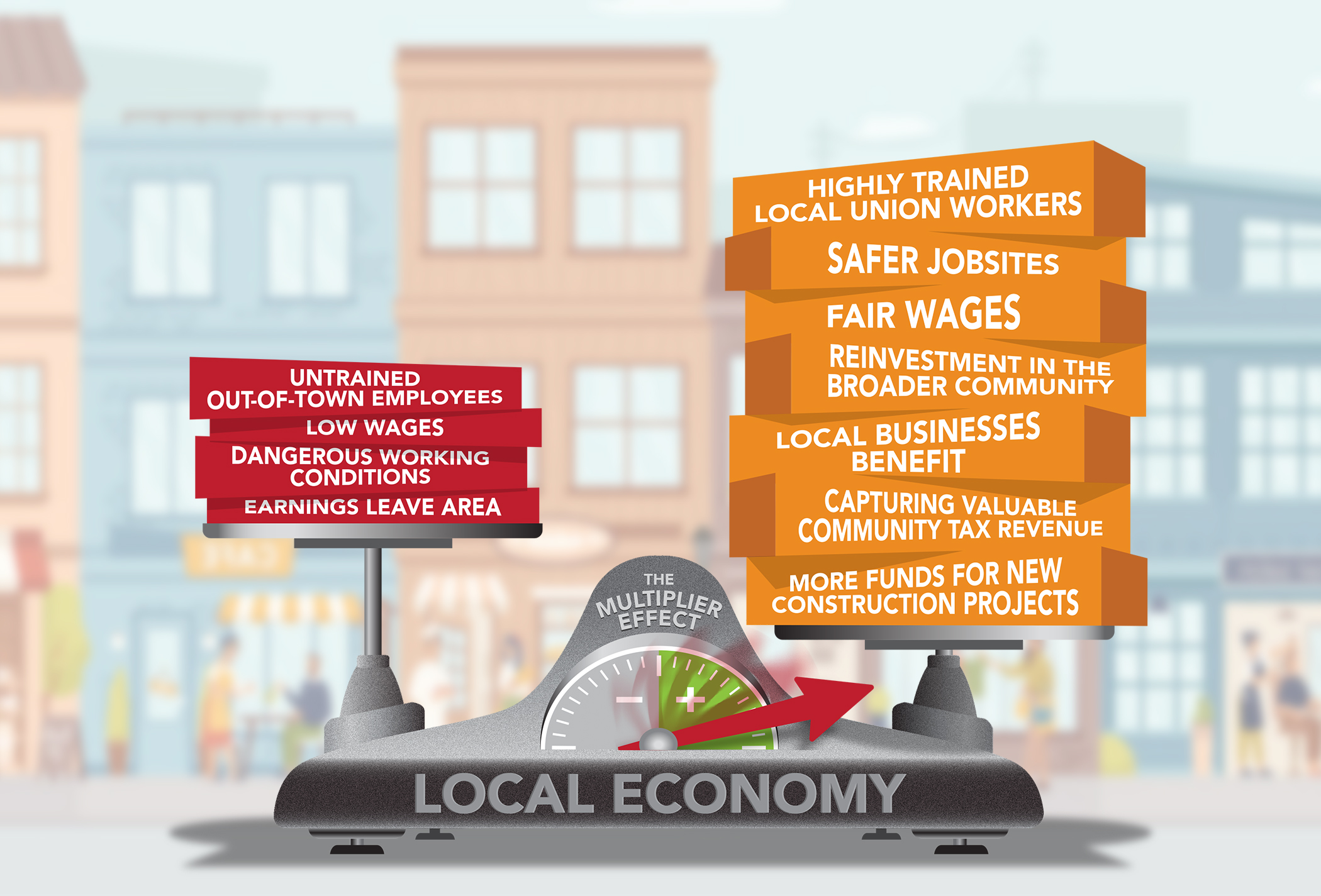
Essentially, considering the multiplier effect expands the scope from just looking at the direct costs of a project to looking at how those costs ripple out through the local economy in positive ways. Fair wages paid to local, Union workers (as opposed to low wages paid to out-of-town employees) means those workers are better able to support their local economy. They take those dollars and reinvest them in the broader community through buying food at the grocery stores and restaurants, spending on healthcare, and making purchases at local retail establishments.
As Union workers, we advocate for our skills because we are highly trained, and because we adhere to strict safety protocols. But we should also advocate for ourselves as a workforce that has tremendous impact on the local economy, and because hiring Union workers is good for other local businesses and a dependable source of tax revenue for the community.
So, next time you’re talking with a neighbor or speaking out for Union involvement in a new construction project at a city board meeting, help decision makers and other voters understand that the wages paid to Union workers are both a project cost and also a source of community income. Supporting Union workers is good for Union families, but it’s just as good for the entire community.